

Let’s be honest—“marketing” is easy to start and hard to scale. Posting on social media, running a few ads, sending a newsletter… that’s not real scaling. Real scaling is when your marketing turns into a predictable machine that brings customers in month after month without you constantly panicking about the next lead.
If you’ve ever wondered, “How do I move from random marketing tactics to a serious growth engine?” this guide on scale up marketing is for you. Think of it as a roadmap from “we’re trying everything” to “we know exactly what works, why it works, and how to multiply it.”
What Does It Mean To Scale Up Marketing?
Scaling up marketing isn’t just “spending more money on ads.” It’s about growing results faster than costs.
When you scale properly:
-
Every rupee or dollar you spend brings in more than it costs.
-
Your campaigns are repeatable, not one‑time “lucky hits.”
-
New customers keep coming in while existing ones stay longer and spend more.
Picture your marketing like a factory. Scaling isn’t adding more chaos to the factory floor. It’s improving the assembly line, automating smartly, and increasing output without burning out your people or your budget.
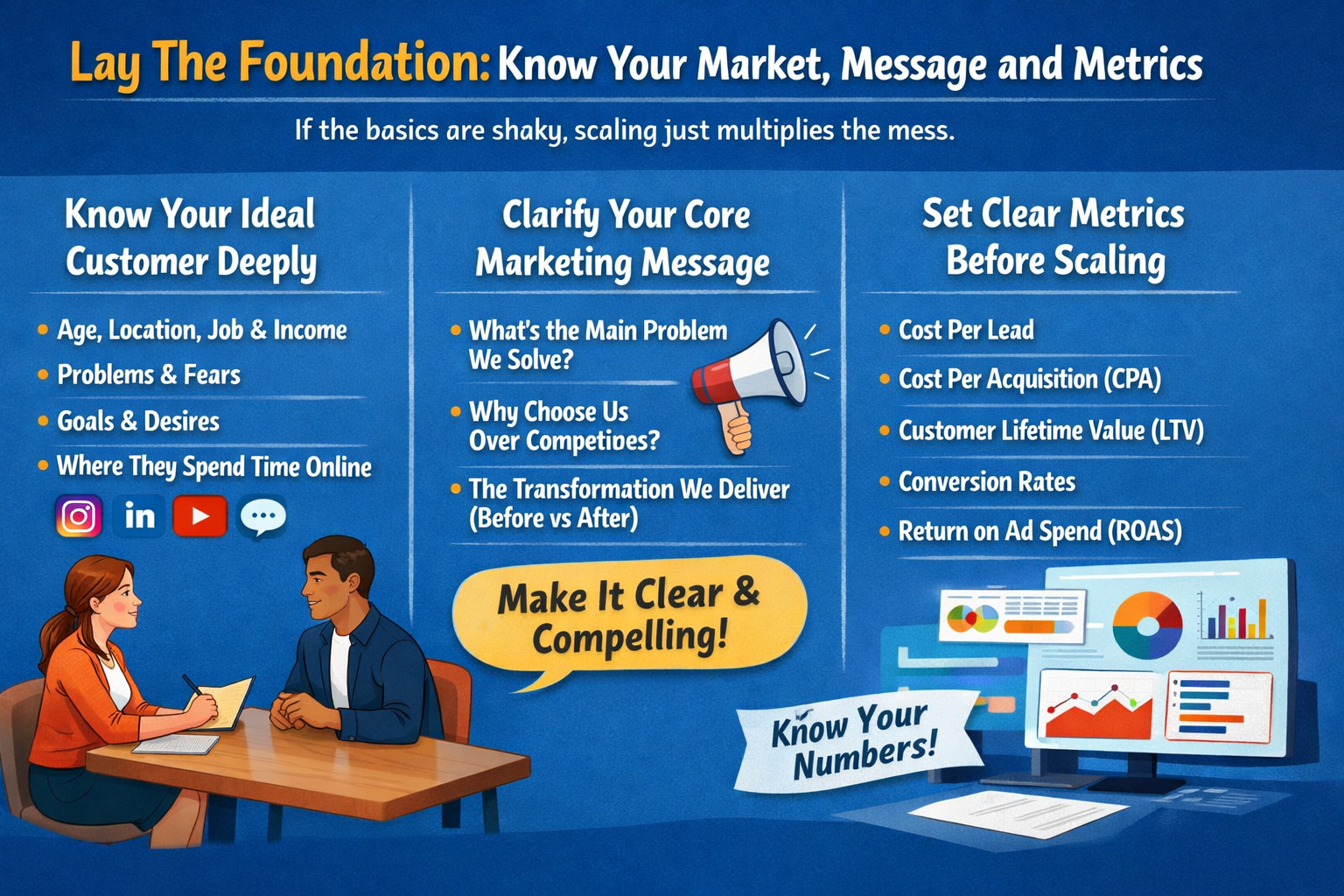
Lay The Foundation: Know Your Market, Message and Metrics
Before you even think about scaling, you need clarity. If the basics are shaky, scaling just multiplies the mess.
Know Your Ideal Customer Deeply
Who are you really selling to? “Anyone who needs our product” is not an answer.
You should clearly know:
-
Their age, location, job, and income
-
Their problems, frustrations, and fears
-
Their goals, dreams, and desired outcomes
-
Where they spend time online (Instagram, LinkedIn, YouTube, forums)
If your ideal customer were a person sitting across the table, could you describe their life in detail? If not, go back and research—talk to current customers, read reviews, run surveys, stalk comment sections.
Clarify Your Core Marketing Message
Scaling demands one thing: a message that hits home repeatedly.
Ask yourself:
-
What is the main problem we solve?
-
Why should someone pick us over competitors?
-
What transformation do we deliver (before vs after)?
Your message should be simple enough that your customer can repeat it for you. If they need a paragraph to explain what you do, you’re not clear enough yet.
Set Clear Metrics Before Scaling
You can’t scale what you can’t measure.
Some core metrics you must know:
-
Cost per lead
-
Cost per acquisition (CPA)
-
Conversion rates (clicks to leads, leads to customers)
-
Return on ad spend (ROAS)
Think of these as your marketing dashboard. Without them, scaling is like driving fast at night with your headlights off.
Positioning: Stand Out Before You Turn Up the Volume
Scaling marketing without strong positioning is like shouting the same thing as everyone else, just louder. People will still ignore you.
Build a Clear, Unique Position in the Market
Ask: “If we disappeared tomorrow, what would our customers miss?”
You can position yourself on:
-
Price (premium, affordable, luxury)
-
Niche (focused on a specific industry, age group, or problem)
-
Quality (better results, faster delivery, stronger guarantee)
-
Experience (best support, easiest process, community, or content)
A simple positioning test: can someone describe your brand in one sentence that doesn’t fit your competitor? If yes, you’re on the right track.
Create a Scalable Marketing Funnel (Awareness to Advocacy)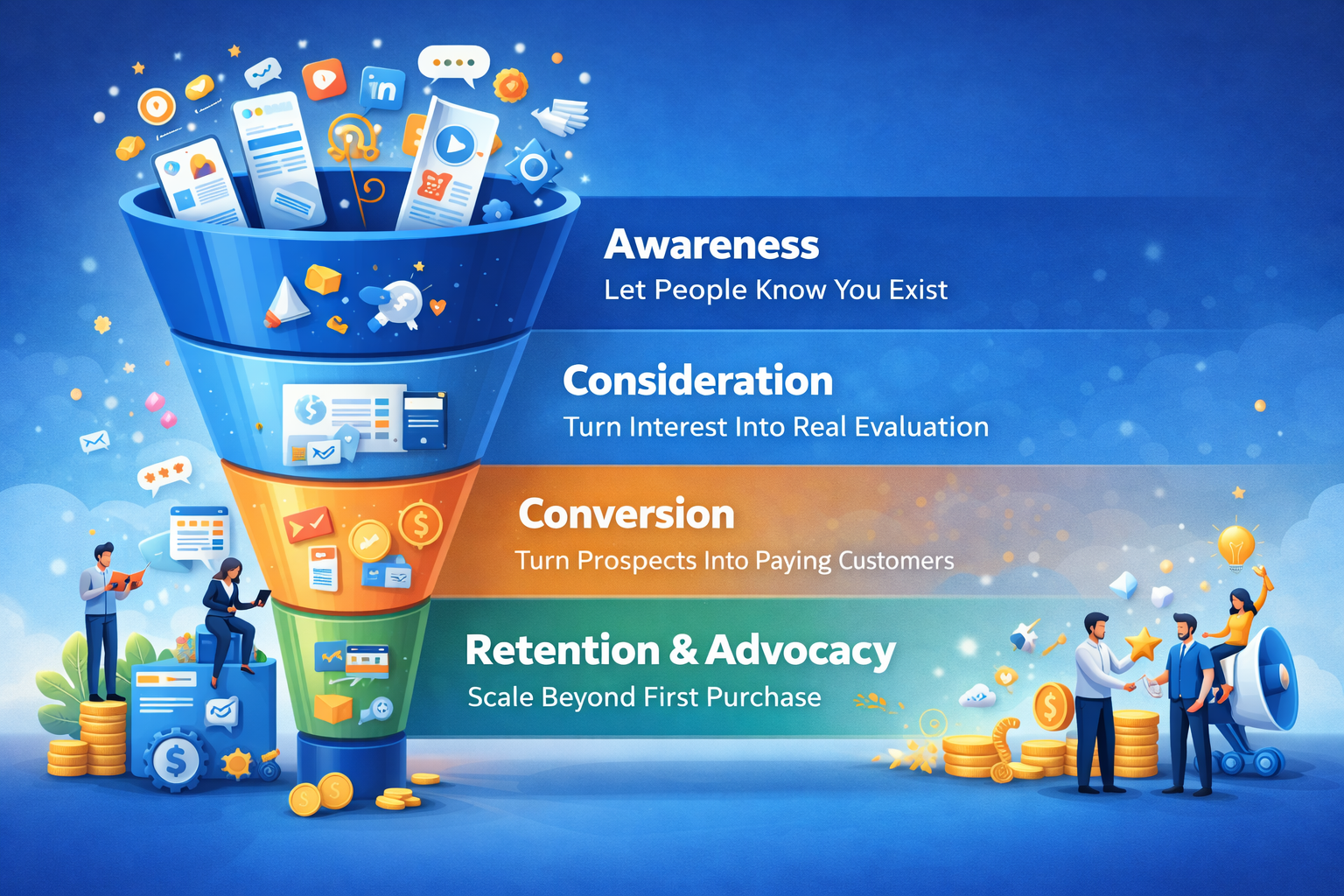
To scale, you need a funnel—not random isolated activities.
Awareness: Let People Know You Exist
At the top of the funnel, your goal is visibility.
High‑leverage awareness channels:
-
Organic content: blogs, YouTube, Instagram, LinkedIn posts
-
Paid ads: search ads, social media ads, display ads
-
PR and media: articles, interviews, podcasts
-
Partnerships: collaborations, affiliate marketing, co‑branded campaigns
At this stage, don’t try to sell hard. Aim to educate, entertain, or inspire. Think of it as introduction, not proposal.
Consideration: Turn Interest Into Real Evaluation
Now people know you exist. Next question: “Why should I care?”
Here you use:
-
Case studies and testimonials
-
Webinars, demos, and free workshops
-
Detailed product/service pages
-
Comparison guides and FAQs
This is where you answer objections, prove credibility, and show results.
Conversion: Turn Prospects Into Paying Customers
This is where the money comes in.
Conversion tools:
-
High‑converting landing pages
-
Limited‑time offers or bonuses
-
Simple checkout flows or booking systems
-
Sales calls for high‑ticket offers
-
Clear guarantees and risk reversal
Your goal? Make it as easy and safe as possible to say “yes.”
Retention and Advocacy: Scale Beyond First Purchase
Scaling doesn’t stop at the sale. It continues after it.
Retention tactics:
-
Email sequences for onboarding and engagement
-
Loyalty programs and rewards
-
Regular check‑ins or value updates
-
Upsells and cross‑sells that solve deeper problems
Happy customers are your cheapest marketing channel—they bring referrals, reviews, and repeat business.
Channel Strategy: Don’t Try Everything, Do the Right Things
If you try to be everywhere at once, you’ll end up weak everywhere. Scaling requires focus.
Choose Your Primary Growth Channels
Think of channels like lanes on a highway. You can’t speed in all of them. You need 1–3 primary lanes.
Some popular options:
-
Content marketing (blogs, SEO, YouTube)
-
Performance marketing (Google Ads, Meta Ads, LinkedIn Ads)
-
Social media marketing (Instagram, LinkedIn, Twitter/X, Facebook)
-
Email marketing and marketing automation
-
Influencer and creator partnerships
Pick channels based on:
-
Where your audience already spends time
-
Your budget and resources
-
Your strengths (writing, video, design, networking)
It’s better to master two channels than dabble in ten.
Use Supporting Channels Wisely
Supporting channels amplify your main ones.
For example:
-
You create a YouTube video (primary) then repurpose clips for Instagram (supporting).
-
You run search ads (primary) and use remarketing on social media (supporting).
Think of your marketing like an ecosystem, not a bunch of disconnected islands.
Content: The Engine of Scalable Marketing
You can’t scale up marketing in 2026 without serious content. Content warms up cold audiences, nurtures leads, and builds trust 24/7.
Build a Content Strategy, Not Random Posts
Instead of asking “What should I post today?”, ask:
-
What are the top 10 questions our audience always asks?
-
What objections do people have before buying?
-
What myths exist in our industry that we can bust?
-
What success stories can we tell?
Turn each of those into:
-
Blog posts
-
Short videos or Reels
-
Long‑form videos or webinars
-
Carousels, infographics, or email sequences
Your content should do the heavy lifting of education, trust‑building, and pre‑selling.
SEO: The Silent, Compounding Growth Machine
SEO isn’t sexy, but it’s one of the most scalable strategies.
Key steps:
-
Do keyword research around your audience’s problems and questions
-
Create in‑depth, high‑quality content that actually answers those queries
-
Optimise titles, meta descriptions, headings, and internal links
-
Build authority with backlinks, guest posts, and collaborations
Think of SEO as planting a tree. It takes time, but once it grows, it gives shade (traffic and leads) for years.
Performance Marketing: Scale With Paid Ads Without Wasting Money
Paid ads are like fire: they can cook your food or burn your house. The difference is how you use them.
Start Small, Scale Only What Works
Don’t begin with huge budgets. Begin with experiments.
Steps:
-
Test multiple creatives, headlines, and audiences
-
Track cost per lead, cost per sale, and ROAS
-
Kill the worst‑performing ads quickly
-
Gradually increase budget on the winners
Avoid the temptation to scale too fast. It’s like accelerating before you’ve learned to steer.
Retargeting: Low‑Hanging Fruit You Can’t Ignore
Most people won’t buy from you the first time they see your ad or website.
Retargeting helps you:
-
Show ads to people who visited your site but didn’t buy
-
Remind people who added to cart but didn’t complete purchase
-
Upsell to past customers
These audiences are warm. They already know you. That’s why retargeting often gives some of the best returns when you scale.
Automation and Tools: Build a Marketing Machine, Not a Manual Mess
You can’t scale if everything depends on you personally doing each small task.
Automate Repetitive but Important Activities
Look for tasks you can automate:
-
Welcome emails and lead nurturing sequences
-
Abandoned cart reminders
-
Appointment confirmations and follow‑ups
-
Review and feedback requests
-
Basic chat responses or lead qualification via chatbots
Automation isn’t about replacing humans; it’s about freeing them to do higher‑value work like strategy, creativity, and relationship‑building.
Use the Right Tools, Not Every Shiny Software
Some useful tool categories:
-
Email marketing platforms (for campaigns and automation)
-
CRM systems (for tracking leads and customers)
-
Ad managers and analytics tools
-
Social media schedulers
-
Landing page and funnel builders
Choose tools that integrate well with each other and match your stage of growth. Don’t pay enterprise‑level prices if you’re still at early scale‑up stage.
Team and Agency: Who Should Run Your Scaling Effort?
As you grow, you’ll eventually face one big question: “Do we build an in‑house team or hire agencies/freelancers?”
In‑House vs Agency: Pros and Cons
In‑house team:
-
Deeper understanding of your brand and customers
-
Faster feedback cycles
-
Long‑term consistency
Agency/freelancers:
-
Access to specialised skills (ads, SEO, design, etc.)
-
Fresh outside perspective
-
Ability to quickly scale up or down
Often, the best setup is a hybrid: a small in‑house core team that manages strategy and brand, supported by agencies for specific channels or campaigns.
Hire for Skills That Scale
When building your team, think like a founder, not just a manager.
Key roles for scaling:
-
Marketing strategist or growth lead
-
Performance marketer (ads)
-
Content lead or copywriter
-
Designer or creative lead
-
Marketing ops/automation specialist
You don’t need all of them on day one, but you should have a roadmap of whom to bring in as you grow.
Data, Testing and Iteration: The Real Secret Behind Scale
Let’s clear this up: brands don’t magically “find” perfect campaigns. They test, fail, learn, and refine—over and over.
Adopt a “Test–Learn–Scale” Culture
Before scaling any idea, ask:
-
Have we tested this on a small scale first?
-
What are we measuring to decide if it worked?
-
How will we tweak if the first version fails?
Examples of tests:
-
Different ad creatives
-
Two landing page designs (A/B testing)
-
Different price points or offers
-
New audience segments
Data should guide your decisions, not ego or guesswork.
Look Beyond Vanity Metrics
Likes and views feel good, but they don’t pay the bills.
Focus on:
-
Leads generated
-
Sales closed
-
Revenue and profit
-
Customer lifetime value
-
Churn and retention
When you scale, your north star is sustainable revenue, not superficial popularity.
Common Mistakes When Scaling Marketing (And How To Avoid Them)
Scaling is exciting, but it’s also where many businesses crash.
Some classic mistakes:
-
Scaling a broken funnel (pushing more people into a system that doesn’t convert)
-
Ignoring existing customers while chasing new ones
-
Copying competitors blindly instead of understanding your own data
-
Overcomplicating tools and setups instead of focusing on basics
-
Burning the team out with chaos, unrealistic deadlines, and constant pivots
If you feel like your marketing team is always “busy” but results don’t move much, you’re probably scaling chaos, not strategy.
Scale Up Marketing for Startups vs Established Brands
The word “scale” looks different depending on where you are.
For Startups and Small Businesses
You need:
-
Fast feedback loops
-
Low‑cost experiments
-
A sharp focus on 1–2 channels
-
Clear product–market fit before aggressive scaling
Don’t rush into big ad spends before you know people truly want what you’re selling.
For Established Brands
You need:
-
Deeper segmentation and personalisation
-
More automation and systemisation
-
Stronger brand differentiation
-
Advanced analytics and attribution models
Your challenge isn’t just growth; it’s efficiency and defending your position.
Future‑Ready Scale Up Marketing: Trends To Watch in 2026
Marketing is changing quickly. To scale smart in 2026 and beyond, keep an eye on these shifts.
Personalisation and AI‑Driven Journeys
Customers now expect experiences tailored to them.
Examples:
-
Dynamic website content that changes based on behaviour
-
Personalised email sequences based on past actions
-
AI‑driven product recommendations
Used correctly, AI becomes your smart assistant, not your replacement.
Short‑Form Video and Creator‑Led Growth
Reels, Shorts, and TikTok‑style videos are still exploding.
To scale:
-
Partner with creators who actually influence your niche
-
Turn customer stories into bite‑sized videos
-
Mix education, entertainment, and subtle selling
Attention is the new currency. Short‑form content is one of the fastest ways to earn it.
Community and Owned Audiences
Relying only on algorithms is risky.
Future‑ready brands:
-
Build email lists
-
Create communities (WhatsApp groups, Discord, Telegram, private forums)
-
Host regular live sessions, AMAs, or workshops
When you own your audience, you’re less vulnerable to platform changes.
Bringing It All Together: Your Scale Up Marketing Blueprint
Let’s wrap this into a simple, practical blueprint.
To scale up marketing in a sustainable way:
-
Understand your ideal customer and sharpen your positioning
-
Build a clear funnel from awareness to retention
-
Pick 1–3 key channels and master them
-
Use content and SEO for compounding growth
-
Use paid ads carefully, with testing and retargeting
-
Automate repetitive tasks and build a lean tech stack
-
Invest in the right people—internal, external, or both
-
Make data your compass and testing your habit
-
Focus on long‑term relationships, not just short‑term wins
Scaling isn’t a one‑time project. It’s an ongoing discipline. But once your system is in place, marketing stops feeling like a gamble and starts feeling like an engine you can control.
Conclusion
At the end of the day, scaling up marketing is not about copying what the biggest brands do; it’s about building a system that fits your business, your audience, and your resources.
Think of your marketing like a sound system. At first, you just want to hear the music. As you grow, you tune the bass, treble, and volume. Scaling is that tuning process. Do it patiently, listen to the feedback, and keep adjusting. Do that, and your marketing doesn’t just get louder—it gets clearer, sharper, and far more powerful.


