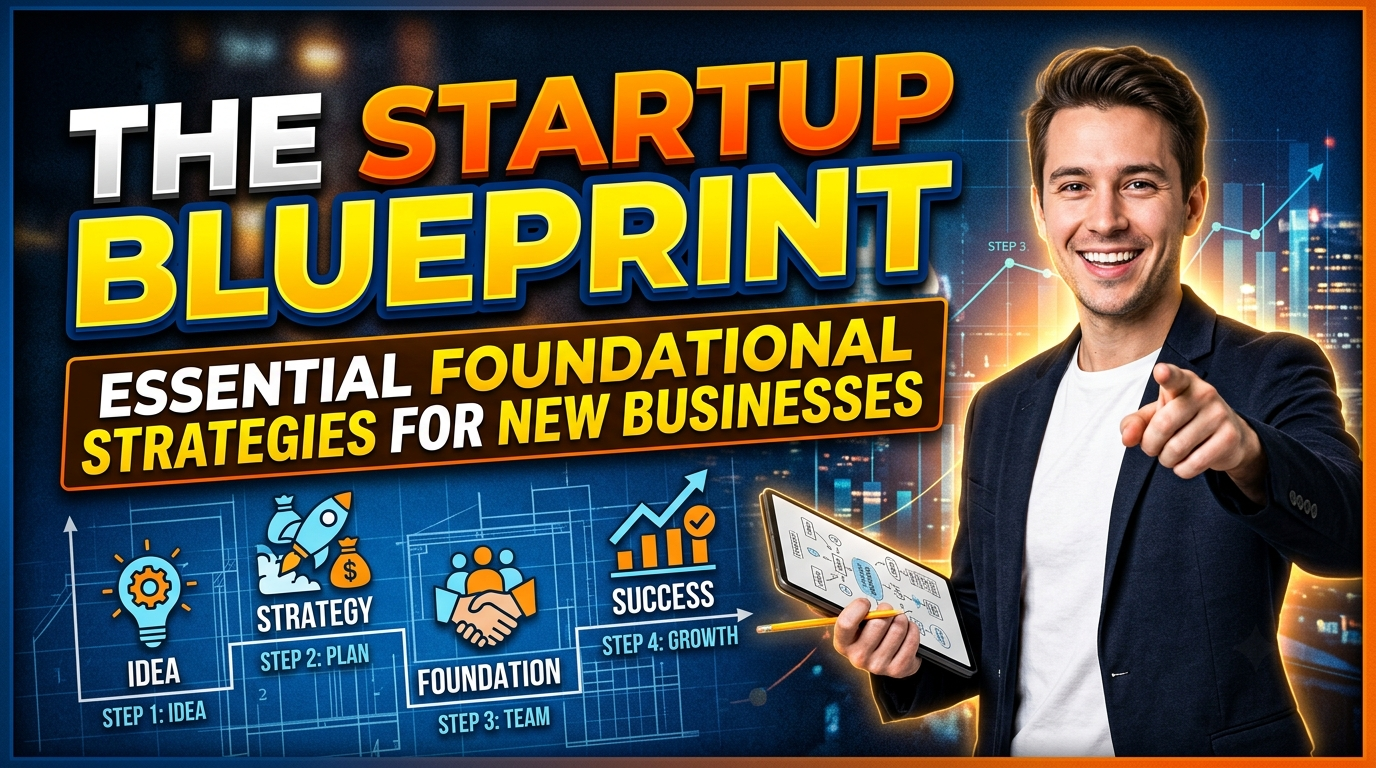
Taking the leap from employee to entrepreneur is one of the most exhilarating decisions a person can make. You have a brilliant idea, a unique skill set, or a revolutionary product that you know the market needs. The initial weeks of starting a company are fueled by pure adrenaline and limitless optimism.
However, as the dust settles, a harsh reality often sets in. Having a great product is only about twenty percent of the equation. The other eighty percent consists of actually running the company—managing finances, establishing a digital presence, identifying target markets, and building operational systems. For a first-time founder, this sudden mountain of responsibility can feel paralyzing. It is incredibly easy to spend precious time and capital on the wrong things, leading to the premature failure of an otherwise brilliant concept.
If you are feeling overwhelmed by the sheer mechanics of launching your startup, you are not alone. Every successful enterprise, from local agencies to massive tech unicorns, started exactly where you are today. In this comprehensive guide, we are going to strip away the complex corporate jargon and focus purely on the foundational elements. We will explore the most critical beginner tips for businesses to help you build a resilient, scalable, and successful company from day one.
Avoiding the “Shiny Object” Syndrome
One of the most common traps that snare new entrepreneurs is “Shiny Object Syndrome.” This is the tendency to focus entirely on the fun, aesthetic, or superficial aspects of a business while ignoring the critical structural work.
Countless founders spend three weeks agonizing over the exact shade of blue for their company logo, ordering custom embossed business cards, and trying to secure the perfect social media handles. Meanwhile, they spend zero hours actually talking to potential customers to see if anyone is willing to pay for their service.
Your logo does not dictate your success; your product-market fit does. As a new business owner, your time is your most valuable asset. The very first of our beginner tips for businesses is to ruthlessly prioritize revenue-generating activities. An ugly website that clearly explains your value proposition and has a functioning checkout page will infinitely outperform a beautifully designed website that lacks a clear business model. Perfect the aesthetics later; prioritize functionality now.
Defining Your Ideal Customer Profile (ICP)
When asked who their target audience is, a novice business owner will often say, “Everyone.” They believe that by casting the widest net possible, they will catch the most fish. In the world of business, the exact opposite is true. If you try to sell to everyone, you will end up selling to no one.
When your messaging is broad, it is watered down. It lacks the sharp, specific emotional hook required to make a prospect pull out their credit card.
Instead, you must define a hyper-specific Ideal Customer Profile (ICP). You need to know exactly who you are serving.
- What is their job title?
- What is their annual income or company revenue?
- What is the primary frustration that keeps them awake at night?
For example, do not be a “business consultant.” Be a “financial consultant specializing in helping independent dental practices reduce their overhead costs.” By narrowing your niche, you immediately eliminate ninety percent of your competition. You transition from being a generic commodity to a highly specialized expert. Once you dominate a small, specific niche, only then should you consider expanding your demographic.
Building a “Lean” Tech Stack
We live in a golden age of business software. There is an application or a cloud-based service for every conceivable business function. However, aggressive software subscriptions can quickly bleed a new business dry before it ever makes its first sale.
Many first-time founders make the mistake of purchasing complex “enterprise-level” software because they think it will make them look more professional. You do not need a $500-a-month Customer Relationship Management (CRM) platform if you only have ten clients.
One of the most pragmatic beginner tips for businesses is to adopt a “lean” technology stack. Build your initial infrastructure using free or low-cost tools until your revenue justifies an upgrade.
- Communication: Use free tiers of Slack or Discord for team communication.
- Project Management: Trello, Asana, and Notion all offer incredibly robust free versions to keep your tasks organized.
- Accounting: Before investing in expensive bookkeeping software, use a simple, highly organized spreadsheet to track your incoming and outgoing cash flow.
- Website: Do not pay an agency $10,000 for a custom-coded website on day one. Utilize website builders with affordable monthly plans to get a clean, professional digital storefront online in a matter of hours.
Only upgrade your tech stack when a specific system physically breaks under the weight of your growing customer base.
Separating Personal and Business Finances
This is perhaps the least glamorous, yet most vital piece of advice for new entrepreneurs: never, under any circumstances, co-mingle your personal and business finances.
When you are just starting out, it is tempting to run business expenses through your personal credit card or deposit client checks into your personal checking account. This is a massive mistake. Co-mingling funds creates a logistical nightmare come tax season, it obscures your true business profit margins, and most importantly, it can pierce your “corporate veil.” If your business is ever sued, having mixed finances means your personal assets (like your house or your personal savings) could be at risk.
Before you make your first sale, legally register your business entity (such as an LLC or an S-Corp, depending on your local laws), obtain an Employer Identification Number (EIN), and open a dedicated business checking account. Every single business expense and every single dollar of revenue must flow exclusively through that account.
The “Ship Early, Iterate Often” Mindset
Perfectionism is the enemy of progress. Many new businesses delay their launch for months, or even years, because the founder is terrified that the product is not completely flawless. They want to add one more feature, tweak one more line of code, or rewrite the sales copy one more time.
The reality of business is that your first iteration will never be perfect, because you are building it in a vacuum. You do not know what the market actually wants until the market interacts with your product.
Embrace the concept of the Minimum Viable Product (MVP). What is the simplest, most stripped-down version of your product or service that still solves the core problem for your customer? Build that, and launch it immediately.
Get it into the hands of real users as fast as humanly possible. Let them find the bugs. Let them complain about the missing features. That real-world feedback is worth its weight in gold. It tells you exactly what to build next, ensuring you do not waste time developing features that no one actually cares about. Ship early, gather data, and iterate often.
Establishing Instant Digital Trust
In the modern business landscape, trust is your most valuable currency. Because anyone can launch a website in twenty minutes, consumers are naturally skeptical of new brands. If they cannot instantly verify that your business is legitimate, they will take their money to a competitor.
As a beginner, you must artificially construct the trust that established brands naturally possess.
- Claim Your Google Business Profile: If you have a physical location or serve a specific local area, this is non-negotiable. It puts you on Google Maps and allows customers to leave public reviews.
- Be Transparent: Do not hide behind a generic “contact@company.com” email address with no physical address listed. Put a real phone number, a real email address, and photos of the real human beings running the company on your “About Us” page.
- Leverage Beta Testers for Social Proof: Offer your product for free or at a steep discount to your first five customers in exchange for a brutally honest, detailed testimonial. Display these reviews prominently on your homepage.
Conclusion: Business is a Marathon of Resilience
Starting a company is not a sprint; it is an ultra-marathon. There will be days when the systems break, a client asks for a refund, or a marketing campaign falls completely flat. This is not a sign that you are failing; it is simply the cost of admission to the world of entrepreneurship.
By focusing on the fundamentals, defining a hyper-specific audience, keeping your operations lean, and launching your ideas quickly, you insulate yourself against the most common startup pitfalls. Keep these foundational beginner tips for businesses at the forefront of your strategy. Protect your cash flow, listen relentlessly to your customers’ feedback, and remember that every massive, industry-dominating enterprise started with a single, imperfect step. Take yours today.