If you’re pouring time and money into digital marketing but still feel like results are random, you’re not alone. Many businesses get a spike of traffic here, a handful of leads there, and the odd sale—but nothing predictable or scalable. That’s where smart digital strategies come in. Instead of trying “everything” and hoping for miracles, you build a focused system that brings you consistent traffic, nurtures real leads, and turns them into paying customers.
In this guide, we’ll walk through practical, 2026‑ready strategies you can actually use—even if you’re not a tech wizard or a huge brand. Think of this as a blueprint to make your website and marketing channels work like a 24/7 sales engine, not a random slot machine.
Understand the Foundation: Traffic, Leads & Sales as One System
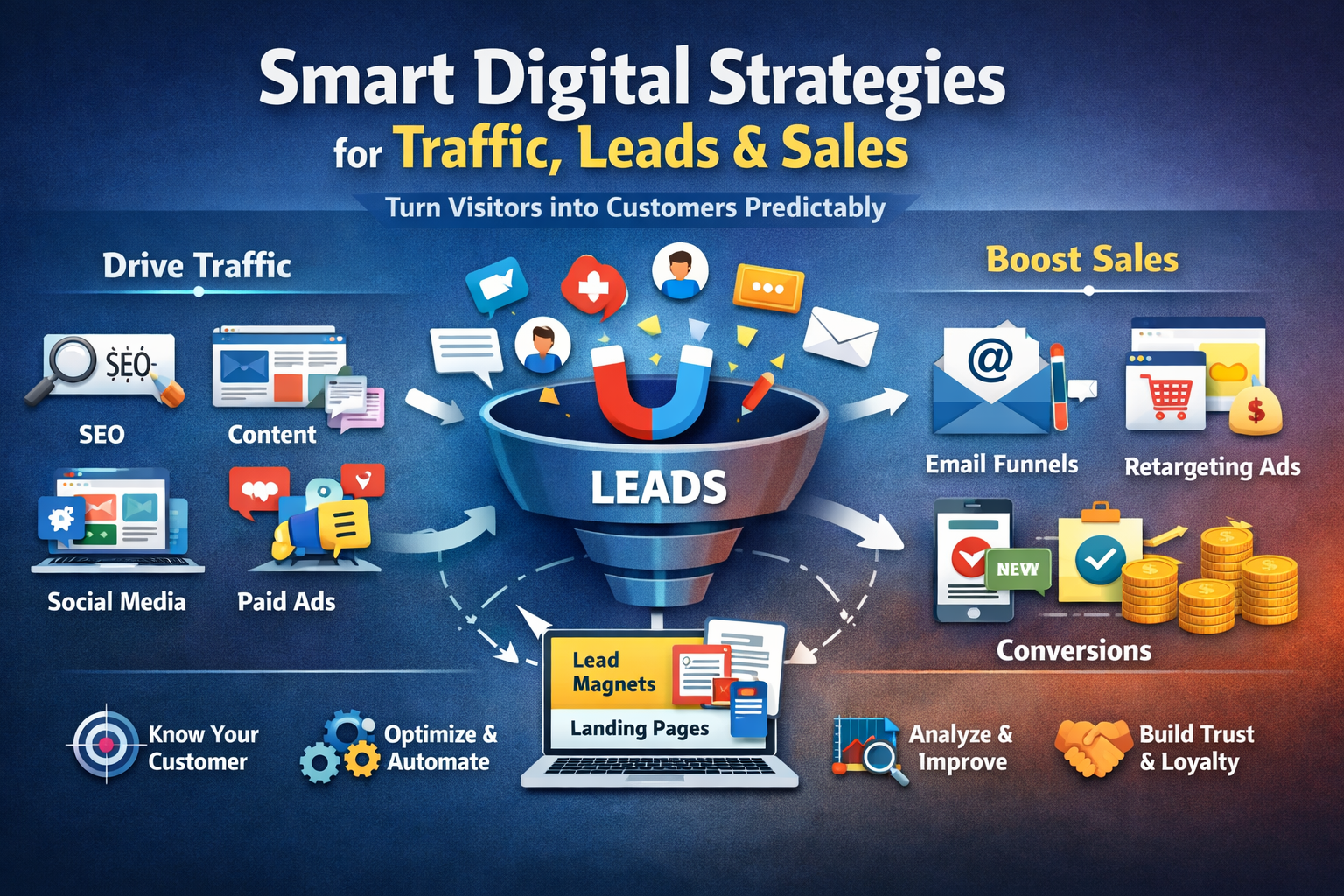
Before you talk tactics, you need to see the big picture. Traffic, leads, and sales are not separate puzzles—they’re stages of the same journey.
-
Traffic is attention. People discover you through search, social, ads, or referrals.
-
Leads are interested visitors who share contact details or show clear intent.
-
Sales are the outcome of trust, clarity, and follow‑up—not just a “Buy Now” button.
If traffic isn’t converting into leads and leads aren’t turning into sales, you don’t have a traffic problem—you have a strategy problem. Smart digital strategies connect these stages so every click has a purpose and every interaction moves people closer to a decision.
Know Your Ideal Customer Before You Spend a Rupee
Here’s a harsh truth: vague marketing kills good products.
You must know exactly:
-
Who your ideal customer is (age, role, industry, location, budget).
-
What problems keep them up at night.
-
What goals they’re chasing (more revenue, better health, more time, status, etc.).
-
Where they hang out online (Google, Instagram, LinkedIn, YouTube, etc.).
When you’re clear on this, everything becomes easier—keywords, content topics, ad copy, offers, even design. It’s like switching on the lights before rearranging a room.
Smart SEO: Get Free, Compounding Traffic Over Time
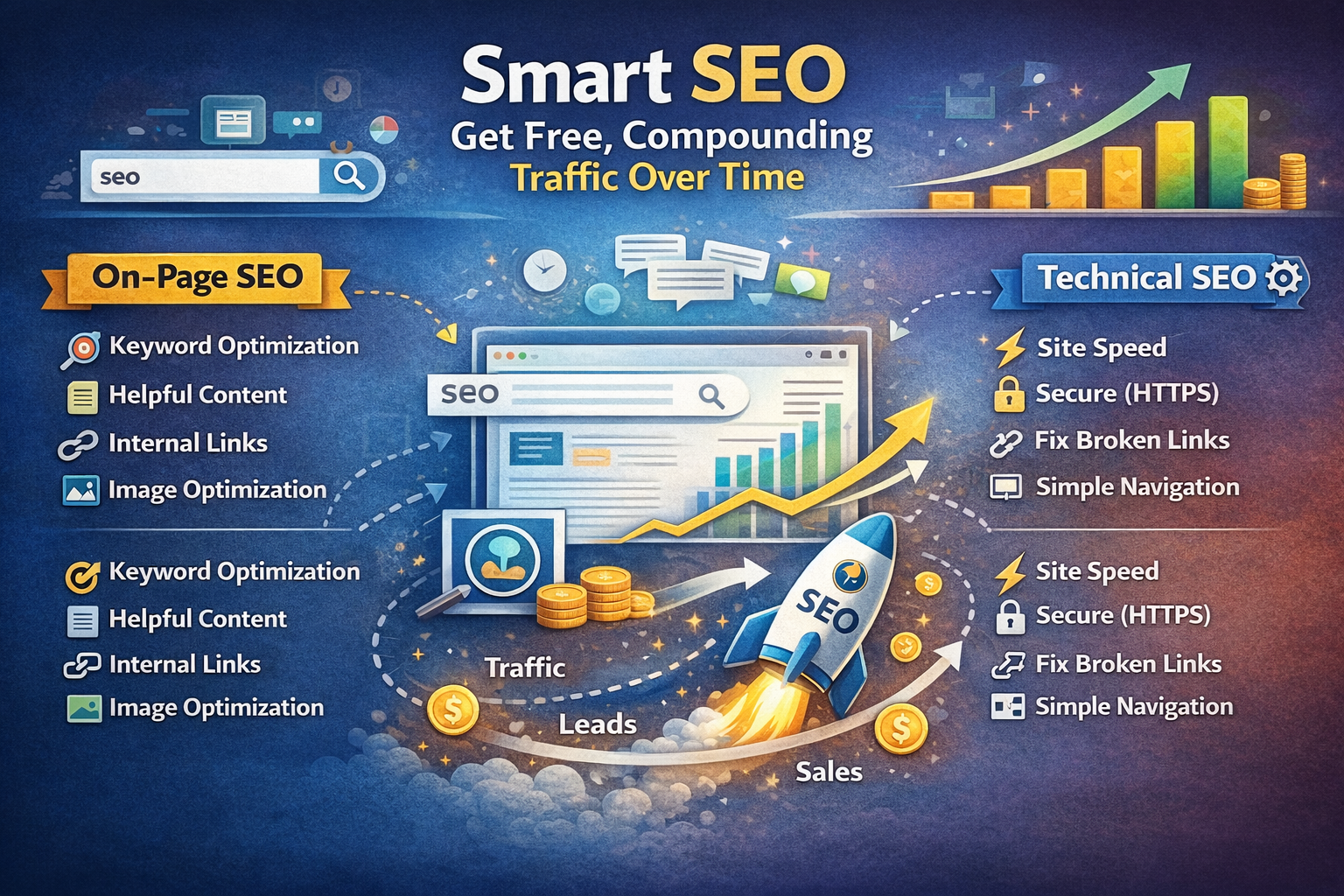
SEO is still one of the smartest ways to grow traffic, because it keeps working long after you publish.
On‑Page SEO: Make Every Page Search-Friendly
You don’t need tricks; you need clarity and structure:
-
Use phrases your audience actually searches for in titles, headings, and content.
-
Write helpful, in‑depth content that answers real questions, not just hits word counts.
-
Add internal links so users (and search engines) can move easily through your site.
-
Optimise images, use descriptive alt text, and keep URLs clean and readable.
Think of each page as a mini “answer hub” for a specific problem. The more value you pack in, the more both people and search engines will trust you.
Technical SEO: Don’t Let Your Site Fight Against You
Even the best content fails if your site is slow or broken.
-
Make sure your site loads fast, especially on mobile.
-
Use HTTPS and a secure, reliable host.
-
Fix broken links and messy redirects.
-
Keep navigation simple so users don’t feel lost.
Good technical SEO is like good road infrastructure: invisible when it works, painfully obvious when it doesn’t.
Content Marketing: Educate First, Sell Naturally
Content marketing isn’t just about blogging; it’s about being genuinely useful. When people learn from you, they trust you—and trust is what makes them share details or pull out their wallet.
Plan Content for Each Stage of the Journey
You don’t talk to a stranger the same way you talk to someone ready to buy, right? Your content should reflect that:
-
Top of funnel (awareness): “What is…”, “Why you should…”, trends, checklists.
-
Middle of funnel (consideration): comparison posts, case studies, detailed guides.
-
Bottom of funnel (decision): demos, FAQs, pricing breakdowns, testimonials.
This way, wherever someone is in their journey, you have the right piece of content waiting like a helpful guide.
Mix Formats: Don’t Rely Only on Blog Posts
People consume information differently. Some read, some watch, some skim. Use:
-
Blog posts and articles.
-
Short‑form videos (Reels, Shorts, LinkedIn clips).
-
Webinars and live sessions.
-
PDFs, checklists, templates, and mini‑courses as lead magnets.
You’re not just producing content; you’re building a library that works for you 24/7.
Social Media: From Random Posts to Strategic Presence
Social media can be a time‑suck or a growth engine—it depends on how you use it.
Pick the Right Platforms (Not All of Them)
You don’t need to be everywhere. Choose platforms where:
-
Your ideal customers already spend time.
-
Your content style fits the platform (visual, text‑heavy, professional, etc.).
-
You can show up consistently.
For example:
-
B2B and services: LinkedIn + YouTube.
-
D2C brands: Instagram + Facebook + short‑form video.
-
Creators/experts: Instagram + YouTube + email.
Post With Purpose, Not Just for the Sake of It
Ask yourself before posting: “What is this supposed to do?”
-
Build awareness? (educational reels, trending topics)
-
Build trust? (case studies, behind‑the‑scenes, stories)
-
Drive traffic? (link to blogs, landing pages, offers)
Mix these like a balanced diet instead of eating only “junk” vanity posts.
Paid Ads: Get Targeted Traffic Fast (Without Burning Your Budget)
Organic growth is powerful but slow. Paid ads are the fast‑lane—if you know how to drive.
Start Small, Test Hard, Scale What Works
Instead of throwing a big budget blindly:
-
Test a few audiences and a few creatives (images, videos, copy).
-
Use clear, specific offers: a free trial, a discovery call, a webinar, a downloadable resource.
-
Track clicks, leads, and actual sales—not just impressions.
Once a combination brings in leads at a cost you’re happy with, then increase the budget. Scaling a bad ad is like turning up the volume on a bad song.
Use Retargeting to Bring Visitors Back
Most visitors don’t convert on the first visit. Retargeting lets you:
-
Show ads to people who visited your site but didn’t act.
-
Promote case studies, testimonials, or specific offers to “warm” prospects.
-
Nudge cart abandoners or page‑viewers back to your funnel.
This is one of the smartest ways to turn “just browsing” into “okay, let me try this.”
High-Converting Landing Pages: Turn Clicks Into Leads
You’ve worked hard (and paid) to get people to your site—don’t lose them on a confusing page.
A smart landing page:
-
Has one clear goal (download, sign‑up, call, purchase).
-
Uses a strong headline that speaks to a specific benefit.
-
Shows social proof (logos, reviews, numbers, testimonials).
-
Uses simple, short forms (only ask what you really need).
-
Has a clear call‑to‑action button that stands out.
Think of a landing page as a focused salesperson, not a brochure. It should guide, not overwhelm.
Lead Magnets & Funnels: Capture Interest While You Have It
Traffic is wasted if you don’t have a way to capture and continue the conversation. That’s where lead magnets and funnels come in.
Create Lead Magnets People Actually Want
Ask: “What can I give in 5–15 minutes that solves a real problem or gives a quick win?”
Examples:
-
Industry checklists (e.g., “21‑point SEO audit checklist”).
-
Calculators (ROI, budget, pricing, savings).
-
Templates (email scripts, ad copy, content calendars).
-
Short guides (“7‑day website traffic boost plan”).
Make the value obvious and specific. “Free ebook” is vague; “Free 10‑step guide to doubling your leads in 30 days” is clearer.
Build Simple, Effective Email Funnels
Once someone opts in, don’t just send a one‑off email and disappear.
Smart funnels:
-
Welcome the new subscriber and set expectations.
-
Deliver the promised resource immediately.
-
Send 3–7 value‑packed emails over the next days/weeks.
-
Gently introduce your paid solution with stories, proof, and clear offers.
Email Marketing: Still the Highest-ROI Channel (If Done Right)
Email isn’t old—boring email is. When done well, it’s one of the highest‑converting channels for leads and repeat sales.
Segment and Personalise Your Emails
Don’t treat everyone the same. Segment by things like:
-
What they downloaded or signed up for.
-
Whether they’ve bought before.
-
Industry or interest.
Then tailor your:
-
Subject lines.
-
Offers.
-
Examples and case studies.
People are far more likely to act when they feel like you’re talking to them, not at a faceless crowd.
Mix Value, Story, and Offers
A smart email calendar might include:
-
Educational tips and how‑tos.
-
Stories of customers or your own journey.
-
Occasional strong offers (sales, launches, new products).
If every email is a pitch, people will tune out. If every email is pure “free value,” they’ll love you but never buy. You need both.
Use Data & Analytics: Guessing Is Not a Strategy
“Smart” in smart digital strategies means data‑driven, not gut‑driven.
You don’t need complex dashboards to start. Focus on:
-
Which channels bring the most qualified traffic (not just visitors).
-
Which landing pages convert best.
-
Which emails get the most opens and clicks.
-
Which campaigns actually generate sales, not just leads.
Every month, look at the numbers and ask:
-
What should we do more of?
-
What should we fix?
-
What should we stop?
Improvement comes from iteration, not inspiration alone.
Automation & Tools: Make the Machine Run Smoothly
You can’t manually follow up with every person on every channel. Automation makes scaling possible without burning out.
You can automate:
-
Welcome sequences after sign‑ups.
-
Abandoned cart reminders for e‑commerce.
-
Lead nurturing for people who downloaded specific resources.
-
Re‑engagement campaigns for inactive subscribers.
The key is not to make automation feel robotic. Use friendly language, logical timing, and options for people to reply or talk to a real human when needed.
Build Trust With Social Proof & Community
People don’t just buy products—they buy confidence.
Smart ways to build trust:
-
Show real reviews and ratings.
-
Highlight client logos or media mentions.
-
Share case studies and before/after results.
-
Build a community space (WhatsApp group, Discord, Facebook group, LinkedIn community) where people can ask questions and see others like them.
When prospects see “someone like me” got results, the resistance drops dramatically.
Turn One-Time Customers Into Repeat Buyers and Advocates
Boosting sales isn’t just about new customers; it’s about getting more value from existing ones.
You can:
-
Offer upsells and cross‑sells that genuinely help.
-
Run loyalty or referral programs with clear rewards.
-
Regularly check in with useful content or usage tips.
The smartest digital strategies treat the first sale as the start of the relationship, not the end.
Bringing It All Together: A Simple, Smart Digital Growth Blueprint
To turn your digital marketing into a growth system, not a gamble:
-
Get clear on your ideal customer and their journey.
-
Use SEO and content for steady, compounding traffic.
-
Use social and paid ads to accelerate visibility and reach.
-
Capture attention with lead magnets and convert with strong landing pages.
-
Nurture with segmented, valuable email sequences.
-
Retarget visitors and leads who didn’t convert the first time.
-
Track data, automate smartly, and refine constantly.
You don’t need to do everything at once. Start with one or two strengths, build momentum, and layer on more as you grow.
Conclusion
smart digital strategies , you don’t win online by shouting the loudest or posting the most. You win by being the most relevant, the most helpful, and the most consistent to the people you want to serve. Smart digital strategies aren’t about complexity; they’re about clarity. When every channel, page, and piece of content plays a clear role in moving someone from stranger to customer, your traffic, leads, and sales stop being a mystery—and start becoming predictable.
Think of your smart digital strategies presence like a well‑designed shop in a busy market. Smart strategies are the signboards, helpful staff, clear aisles, free samples, and smooth billing that turn casual walk‑ins into loyal regulars. You don’t control how many people walk by the market, but with the right system, you absolutely can control how many walk out of your shop with a smile and a purchase.