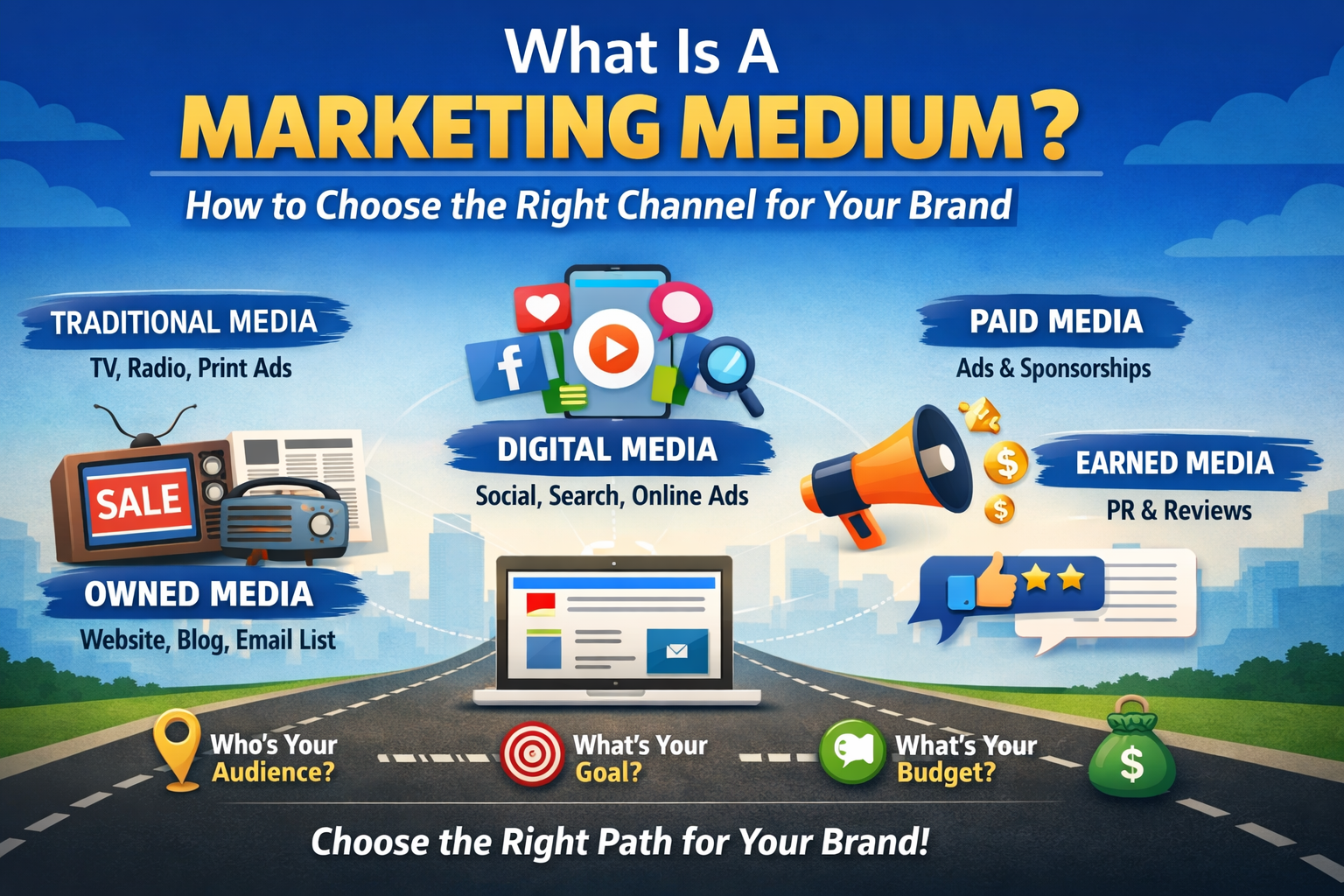
If you’ve ever wondered why some brands blow up online while others barely get noticed, the answer usually starts with one thing: the marketing medium they choose. A marketing medium is simply the channel you use to deliver your message to your audience—think social media, email, TV, billboards, blogs, and more. Different mediums work like different roads leading to the same destination: your customer.
But here’s the tricky part: not every road is right for every brand. So, how do you decide which medium deserves your time, energy, and budget? Let’s break it down in a simple, conversational way so you can make smarter choices for your marketing.
What Is A Marketing Medium? (In Plain English)
Let’s strip away the jargon. A marketing medium is the platform or method you use to communicate with people about your product, service, or brand. It’s the “how” in your marketing message.
For example:
-
Instagram is a medium.
-
Email is a medium.
-
TV ads are a medium.
-
A blog post is a medium.
Your message might stay similar (“We help you save time,” “We sell eco‑friendly products”), but the medium changes how that message looks, feels, and reaches people. Think of it like telling the same story to different crowds—on a stage, in a video, in a text, or over coffee. The story’s core is the same, but the delivery changes everything.
Types Of Marketing Mediums: The Big Picture
To make sense of marketing mediums, it helps to group them into broad categories. That way, you’re not staring at a messy list of options feeling overwhelmed.
Here are some of the main types:
-
Traditional media – TV, radio, newspapers, magazines, outdoor ads like billboards and posters.
-
Digital media – Social media, websites, search engines, apps, email, online ads.
-
Owned media – Channels you control: your website, blog, app, newsletter, and brand social profiles.
-
Paid media – Any medium you pay to access: ads on Google, Facebook, TV, influencers, sponsorships.
-
Earned media – Coverage you don’t pay for directly: word of mouth, PR mentions, reviews, shares.
Each type plays a different role. You don’t need all of them at once, but you do need the right mix for your audience and goals.
Traditional Marketing Mediums: Still Relevant Or Outdated?
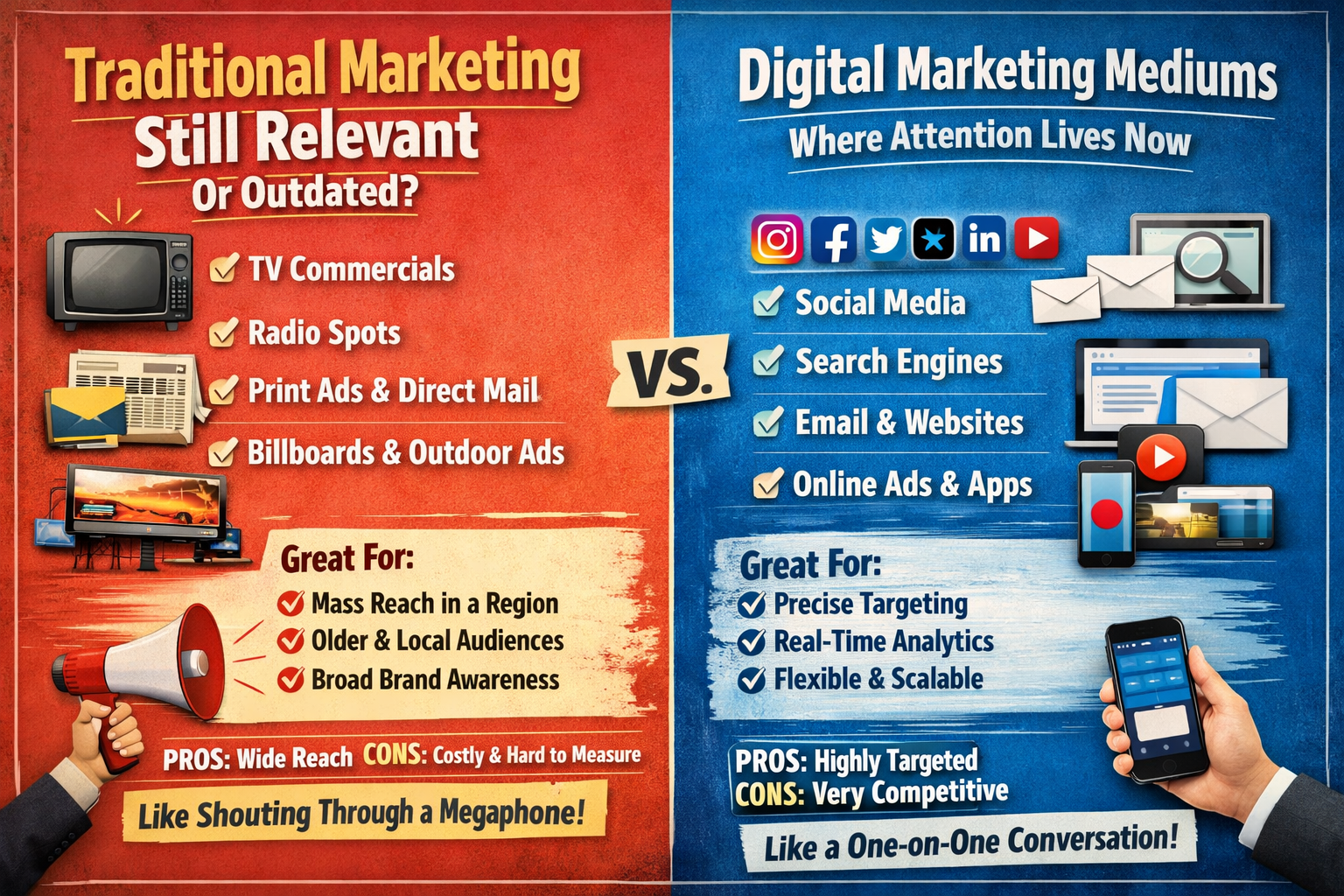
You might think TV and radio are dinosaurs in the digital age, but they’re very much alive—just not for everyone.
Common traditional mediums include:
-
TV commercials
-
Radio spots
-
Newspaper and magazine ads
-
Flyers, brochures, and direct mail
-
Billboards, bus ads, and outdoor signage
These channels work well when:
-
You want mass reach in a specific region or country.
-
Your audience consumes a lot of traditional media (for example, older demographics or certain local markets).
-
You’re building brand recognition and trust on a broad scale.
The downside? Traditional mediums can be expensive, hard to measure precisely, and less targeted. You’re often speaking to a crowd, not a carefully filtered audience. It’s like shouting through a megaphone instead of sending a direct message.
Digital Marketing Mediums: Where Attention Lives Now
If traditional media is the megaphone, digital media is the one‑on‑one conversation—at scale. Most brands, especially growing ones, lean heavily on digital mediums.
Key digital mediums include:
-
Social media platforms (Instagram, Facebook, LinkedIn, X, TikTok, YouTube)
-
Websites and landing pages
-
Blogs and online articles
-
Email newsletters
-
Mobile apps and push notifications
-
Online display and video ads
Why digital mediums matter so much:
-
You can target very specific audiences.
-
You can measure almost everything—clicks, views, sign‑ups, sales.
-
You can test, tweak, and optimize in real time.
The flip side? Digital spaces are crowded. You’re fighting for attention in a feed that refreshes every second. Good content and smart strategy are non‑negotiable.
Owned, Paid, And Earned Media: The Three Pillars
Instead of thinking about “where” to show up, think about “how” you show up across three main pillars.
-
Owned media
These are channels you control completely. Examples:-
Your website
-
Your blog
-
Your email list
-
Your official social pages
Pros: You’re not at the mercy of algorithms or external rules (at least not entirely). You can build long‑term relationships and store content permanently.
Cons: It takes time to grow. You’ll often need paid or earned support to bring traffic here. -
-
Paid media
These are channels where you buy visibility. Examples:-
Google Ads
-
Social media ads
-
Sponsored posts
-
Influencer partnerships
-
Sponsored newsletters
Pros: Fast reach, controllable targeting, predictable volume (as long as you pay).
Cons: Stop paying and visibility drops. Poor campaigns can burn budget fast. -
-
Earned media
This is exposure you gain organically. Examples:-
Positive reviews
-
Social shares
-
PR coverage and news mentions
-
Word‑of‑mouth referrals
Pros: Highly trusted because it doesn’t look like an ad. Often has more credibility.
Cons: Harder to control, slower to build, and unpredictable. -
A strong marketing strategy usually balances all three. Think of owned as your “home base,” paid as your “booster,” and earned as your “reputation.”
Social Media As A Marketing Medium: Your Digital Stage
Social media is often the first medium that comes to mind today—and for good reason. It’s where people hang out, scroll, and interact daily.
Popular social mediums include:
-
Instagram – Visual storytelling, reels, carousels, DMs.
-
Facebook – Communities, groups, local audiences, ads.
-
LinkedIn – B2B, hiring, professional branding.
-
TikTok – Short, viral video content, trends, challenges.
-
YouTube – Long‑form and short‑form video for education and entertainment.
Social media works well when you want to:
-
Build a community around your brand.
-
Show personality, not just products.
-
Engage in real‑time conversations.
-
Create shareable content that travels beyond your own profile.
But remember: social media isn’t just posting pretty pictures. Each platform is its own medium with its own culture. What works on LinkedIn might flop on TikTok, and vice versa.
Email Marketing: The Underrated Powerhouse Medium
Email might feel old‑school compared to social media, but it’s still one of the most effective mediums for nurturing relationships and driving conversions.
Why email is such a powerful medium:
-
You own your list; no algorithm decides who sees your message.
-
It’s direct and personal—you land in someone’s inbox, not their general feed.
-
It’s great for follow‑ups, offers, product launches, and storytelling.
Use email for:
-
Welcome sequences and onboarding.
-
Newsletters and updates.
-
Exclusive discounts or early access.
-
Educational content that builds trust.
Think of email as having a private conversation with your audience at scale. While everyone else shouts on social, you’re whispering directly in someone’s ear.
Content Marketing: When The Medium Is Information
Content isn’t just “blogging.” It’s a strategy where you use helpful, relevant information as the medium to attract and engage your audience.
Common content mediums:
-
Blog posts and guides
-
E‑books and whitepapers
-
Webinars and online workshops
-
Podcasts
-
Infographics and downloadable resources
Content marketing works when you:
-
Want to educate your audience.
-
Need to build authority in your niche.
-
Sell something that requires trust or explanation.
Instead of saying, “Buy from us,” content says, “Here’s something useful,” and then lets trust do the heavy lifting over time.
Influencer And Affiliate Marketing: Borrowing Other People’s Mediums
Sometimes, your best medium isn’t your own—it’s someone else’s platform and audience.
Two key approaches:
-
Influencer marketing – Partnering with creators who have a loyal following on platforms like Instagram, YouTube, TikTok, or LinkedIn.
-
Affiliate marketing – Paying individuals or partners a commission for driving traffic or sales through their own channels.
Why this works:
-
Influencers have built trust with their audience.
-
A recommendation from a creator can feel more authentic than a traditional ad.
-
Affiliates expand your reach without upfront ad spend; you pay per result.
Here, the marketing medium is the influencer’s voice, content style, and platform. You’re essentially renting their spotlight.
How To Choose The Right Marketing Medium For Your Business
With so many options, it’s easy to feel lost. But you can simplify the decision by asking a few key questions:
-
Who is my audience, and where do they spend time?
-
Teenagers on TikTok? Professionals on LinkedIn? Shoppers on Instagram?
-
Don’t choose a medium just because it’s trendy; choose it because your audience is there.
-
-
What is my goal?
-
Brand awareness? Leads? Sales? Community building?
-
Different goals align better with different mediums.
-
-
What is my budget and capacity?
-
Can you afford paid ads? Do you have time to create regular content?
-
One well‑managed medium is better than five neglected ones.
-
-
What kind of content can I create consistently?
-
If you hate being on camera, maybe long‑form written content or podcasting suits you better.
-
If you love visuals, Instagram, Pinterest, and TikTok might be ideal.
-
-
How will I measure success?
-
Before choosing a medium, decide what metrics actually matter: clicks, sign‑ups, sales, engagement, reach, etc.
-
The right medium is the one where your audience is active, your message fits the format, and you can show up consistently without burning out.
Single Medium vs Multi‑Channel: Should You Be Everywhere?
You’ve probably heard the advice: “Your brand needs to be everywhere.” That sounds good, but in practice, it often leads to weak, scattered efforts.
Here’s a more realistic approach:
-
Start strong on one or two key mediums.
-
Learn what resonates, refine your message, and build a base.
-
Once you’re stable, gradually expand into new mediums with intention.
Multi‑channel marketing can be powerful—imagine someone seeing your brand on Instagram, then searching your blog, then joining your email list. But that only works if each medium is handled well. Being “everywhere” but doing a poor job can actually harm your brand.
Common Mistakes When Choosing A Marketing Medium
If you want to avoid wasting time and money, watch out for these common pitfalls:
-
Chasing trends blindly
Jumping on every new platform just because others are, without checking if your audience is there. -
Ignoring your strengths
If you write brilliantly but hate video, forcing a TikTok strategy might not be the best first step. -
Expecting instant results
Most mediums need consistency over time. One blog post or one ad campaign won’t change everything overnight. -
Copying competitors without context
Just because a competitor is crushing it on YouTube doesn’t mean that’s automatically your best medium too. -
Not adapting the message to the medium
Copy‑pasting the exact same content across all channels without adjusting format, tone, or length.
Choosing a medium is a strategic decision, not a random spin of the wheel.
Conclusion
At the end of the day, a marketing medium is more than just a channel—it’s a filter that shapes how people experience your brand. A story told in a heartfelt email feels different from the same story in a 15‑second reel or a billboard. None is “right” or “wrong” in isolation; they’re just different tools.
Your job isn’t to use every tool in the box. It’s to pick the ones that fit your audience, your goals, and your own strengths. When the right message meets the right medium, marketing stops feeling like noise and starts feeling like a real conversation.
So, what should you do now? Don’t try to redesign your entire marketing universe overnight. Instead, pick one action:
-
Choose one medium you want to focus on for the next 60–90 days.
-
Define a simple goal for that medium (e.g., “grow my email list,” “get 50 leads,” “increase website traffic”).
-
Show up consistently with content that actually helps, entertains, or inspires your audience.
Once you’ve tested, learned, and improved in that medium, you’ll be in a much better position to add others. Marketing isn’t about being loud everywhere—it’s about being meaningful somewhere.